Buying · 7 min read
What a salvage or branded title really costs you
The repair is the smallest of the four costs a brand puts on a car. What salvage and rebuilt mean, where the other three costs hide, and how to measure your own discount instead of borrowing somebody else’s percentage.
Published September 23, 2026 · Updated October 8, 2026
By Winnie
Senior Sales Specialist, Bucepha
The repair is the smallest of the four costs a brand puts on a car. That’s why an estimate built from reconditioning alone is reliably too optimistic, and why branded cars that looked cheap in the lane are still on lots months later.
A branded title isn’t a discount applied to a normal car. It changes who buys the car, how they pay, how long it sits and what you’ll have to say about it. Price it as a different deal.
What the words on the title mean
- Salvage: an insurer declared a total loss. In most states the car can’t be registered in that condition, and the brand stays with the title.
- Rebuilt or reconstructed: a salvage car repaired and passed through a state inspection. Roadworthy, registerable, still branded.
- Flood, hail, theft recovery, lemon: different causes, the same retail problem. Your customer sees a word they have to be talked past.
Rules differ by state, and cars move between states. So the brand in front of you is a fact, and the story behind it is an inference.
Four costs, and only one shows up on an invoice
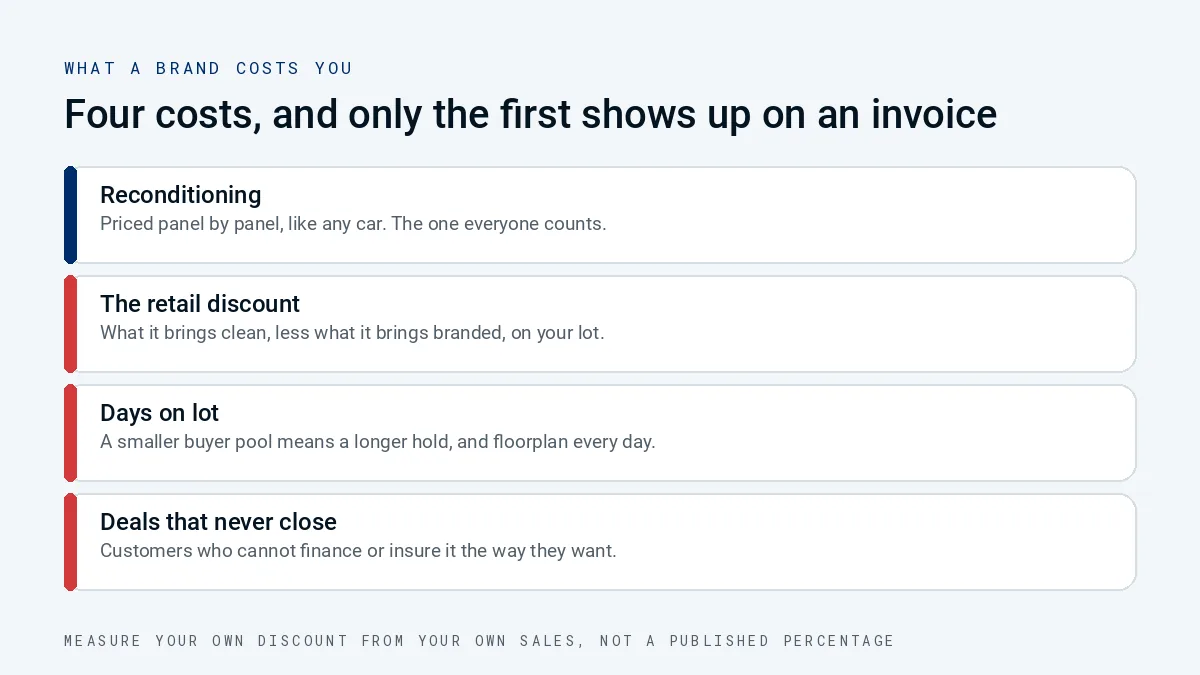
- Reconditioning. Priced panel by panel, like any car. See pricing reconditioning before you bid.
- The retail discount. What the same car brings clean, less what it brings branded, on your lot.
- Days on lot. A smaller buyer pool means a longer hold, and floorplan accrues on every one of those days.
- Deals that never close. Customers who can’t get financing, or can’t insure it the way they want. Each is a deal you worked in full and didn’t finish.
The third and fourth are the ones that hurt, because neither appears anywhere. They appear as a car that’s still on the lot in March.
Measure your own discount. Don’t borrow one.
Published percentages describe somebody else’s market. Your number comes from your own sales: branded cars you retailed, against clean equivalents in the same period, including the extra days each one sat. If you’ve never retailed a branded car, you don’t have that number yet, and the first one you buy is the experiment that produces it. Size the experiment accordingly.
Working back to a bid
Start from what a branded car like this actually sold for on your lot, not from clean book with a haircut. Subtract reconditioning at your own rates, transport, auction fees, floorplan for the longer hold, and the gross you need. What’s left is the ceiling.
Disclose early. It’s cheaper.
The brand reaches your customer through their own history report, at the moment trust matters most. Raised first, it costs you some room. Discovered at signing, it costs you the deal and the referral.
Where photos still earn their keep
A branded car with a documented, competent repair is a different proposition from one with no paperwork, and the photos are often your only evidence of which you’re looking at. Even gaps, continuous reflections and no overspray on trim say the repair was done to last. How to read auction photos covers what to look for, and it matters more on branded stock than on anything else you buy.
Our take
Branded stock works as a line of business and fails as an impulse. If you can’t answer “what did my last five branded cars actually retail for, and how long did they sit”, we’d skip the cheap one in today’s lane and buy the clean car instead.
Common questions
- How much less is a salvage title car worth?
- There is no dependable single percentage, and anyone quoting one is guessing about your market. What is reliable is the shape: a branded car retails for meaningfully less than the same clean car, sits longer, and fewer buyers can finance it. Measure the gap from your own completed sales.
- What is the difference between salvage and rebuilt?
- Salvage generally means an insurer declared a total loss and the car is not currently registerable. Rebuilt, or reconstructed, means a salvage car was repaired and passed a state inspection. The brand stays on the title either way, and the rules differ by state.
- Can you finance or insure a rebuilt title car?
- Often, but not everywhere and not on the same terms. Some lenders decline branded titles and some insurers will write liability but not full coverage. That shrinks your buyer pool, which shows up as days on lot rather than as a line on an invoice.
- Should I tell customers about a branded title?
- Yes, and early. The brand is on the title and in their history report, so it reaches them anyway. Raising it in the first conversation costs some negotiating room; having it surface at signing costs the deal.
- Should a dealership buy salvage title cars at all?
- As a deliberate line of business, it can work: buy knowingly, recondition to a standard, disclose plainly, sell to buyers who came for the price. As an opportunistic buy because one looked cheap in a lane, it usually goes wrong.